Hot Water Tank Heat Exchanger Systems: A Practical Guide for Homeowners
A hot water tank heat exchanger transfers heat from a separate heating source into the water stored in a tank. These systems can provide an efficient way to heat domestic water while allowing the water heater to work alongside boilers, solar systems, heat pumps, or other heat sources.
What Is a Hot Water Tank Heat Exchanger?
A heat exchanger is a component designed to transfer thermal energy from one fluid to another without necessarily mixing the two fluids. In a hot water tank system, the heat exchanger allows heat from a heating source to warm the domestic water inside the storage tank.
One common example is an indirect water heating system. Instead of sending household water directly through a boiler, a separate heating fluid circulates between the boiler and the tank. The heat is then transferred to the domestic water through a heat exchanger.
The U.S. Department of Energy describes indirect water heaters as systems where a separate heating fluid transfers heat to water stored in a tank. This arrangement can help reduce boiler cycling and make effective use of an existing heating system.
How Does a Heat Exchanger Work?
The basic process is relatively straightforward.
A boiler or another heat source heats a fluid. A pump then moves that heated fluid through the heat exchanger. As the hot fluid passes through the exchanger, thermal energy moves through the exchanger material and into the cooler water surrounding it.
The heated domestic water remains inside the storage tank while the heating fluid follows its own separate path.
Depending on the system design, the heat exchanger may be located inside the tank or outside the tank.
An internal heat exchanger is commonly designed as a coil located inside the storage tank. An external heat exchanger can be installed outside the tank and connected to the tank through piping and circulation components. Both approaches are used in different heating applications.
Common Types of Hot Water Tank Heat ExchangersInternal Coil Heat Exchangers
An internal coil is installed directly inside the storage tank. Heated fluid flows through the coil while the surrounding domestic water absorbs the heat.
This design is relatively compact and can be convenient when the tank and heat source are designed to operate together.
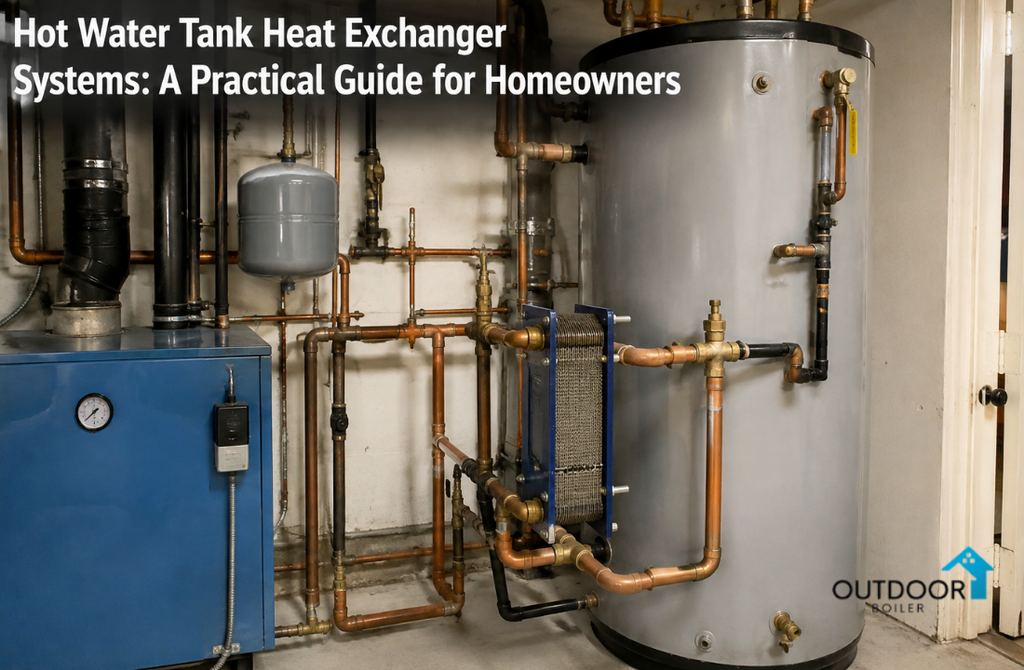
External Plate Heat Exchangers
A plate heat exchanger is installed outside the tank. It contains multiple plates that create separate flow paths for the heating fluid and domestic water.
Because the two fluids flow through separate passages, heat can move between them without the fluids mixing. External exchangers can provide considerable heat transfer in a relatively compact component.
Solar Heat Exchangers
Solar thermal systems can also use heat exchangers to transfer energy collected from solar panels into domestic water. In an indirect solar system, a separate heat transfer fluid can circulate through the solar collectors and then transfer its heat to the water inside a storage tank.
This approach can be useful in climates where the heating fluid needs protection from freezing conditions.
Why Use a Heat Exchanger With a Hot Water Tank?
One of the biggest advantages is flexibility. A storage tank with a heat exchanger can potentially work with different heat sources, depending on the design.
For example, a home may use a boiler for space heating and also use that boiler to provide heat for domestic hot water. The tank stores heated water so it can be available when needed.
Another advantage is separation. The domestic water does not necessarily need to travel through the boiler or heating equipment. Instead, heat is transferred through the exchanger.
This can be particularly useful when the heating source and domestic water system require different operating conditions.
Heat Exchanger Efficiency
The efficiency of a heat exchanger depends on several factors, including its surface area, materials, temperature difference, flow rate, system design, and maintenance.
A larger temperature difference between the heating fluid and the stored water can increase the potential rate of heat transfer. However, the system still needs to be properly controlled to maintain suitable water temperatures.
Insulation is also important. Even an efficient heat exchanger cannot prevent heat loss from a poorly insulated storage tank or distribution piping.
The U.S. Department of Energy notes that water heating is a significant portion of household energy use, which makes system efficiency an important consideration when selecting and operating water heating equipment.
Choosing the Right System for Your Home
Homeowners should consider several factors before choosing a hot water tank heat exchanger system.
First, consider the available heat source. A system connected to a boiler may have different requirements from one designed for solar thermal heating or another energy source.
Next, consider household hot water demand. A small household may require less storage and heat transfer capacity than a larger family with multiple bathrooms and appliances using hot water simultaneously.
Tank size, heat exchanger capacity, operating temperature, available space, piping layout, and circulation requirements should also be considered.
It is important to size the entire system rather than selecting the tank or heat exchanger independently. An appropriately sized system can provide more consistent hot water performance and avoid unnecessary energy use.
Maintenance and Common Problems
Like other water heating equipment, heat exchanger systems require appropriate maintenance.
Mineral deposits can accumulate on heat transfer surfaces, particularly in areas with hard water. Scale buildup can reduce heat transfer and make the system work harder.
Corrosion, leaks, blocked circulation lines, faulty pumps, and temperature control problems can also affect performance.
Homeowners should pay attention to changes such as slower water heating, inconsistent temperatures, unusual noises, visible leaks, or frequent cycling of the heating equipment.
Professional inspection may be appropriate when these problems occur, especially when the system involves boilers, high temperatures, pressure, or complex plumbing connections.
Is a Heat Exchanger Right for Your Home?
A hot water tank heat exchanger can be a practical solution when a home already has a suitable heat source or when the homeowner wants to integrate multiple heating technologies. The main benefit is the ability to transfer heat efficiently while keeping the heating fluid and domestic water in separate circuits.
However, the right system depends on the home’s hot water demand, existing equipment, climate, available space, and installation requirements. Proper sizing and installation are essential for reliable performance.
Final Thoughts
Understanding how a hot water tank heat exchanger works can make it easier to evaluate different water heating options and determine what may be suitable for your home. From internal coils to external plate exchangers, these systems can support a variety of heating arrangements when they are properly designed and maintained.
If you are considering a new water heating setup or want to understand how a heat exchanger could work with your existing system, contact us or visit our website at outdoorboiler.com to learn more and discuss your options with our team.
Kelsey W. Popham